
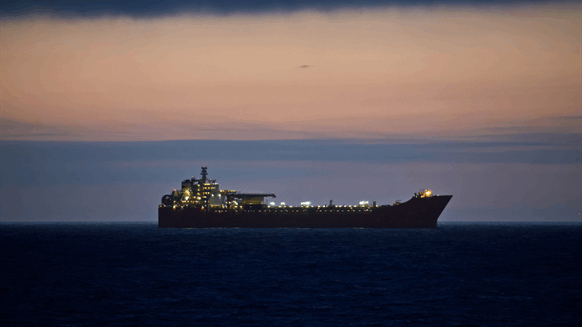
Equinor ASA and its partners have started up the Verdande field in the Norwegian Sea, the second project to be tied back to the Norne floating production, storage and offloading vessel (FPSO) this year.
“With reserves of 36 million barrels of oil, Verdande helps extend Norne’s production beyond 2030”, the Norwegian majority state-owned company said in an online statement.
“The Norwegian continental shelf is changing, and many of the fields being developed are smaller subsea fields tied back to existing infrastructure”, Equinor said. “This approach reduces both costs and environmental footprint”.
Verdande mainly contains oil, with associated gas, according to Equinor. It holds the Cape Vulture and Alve Nord East discoveries, proven in 2017 and 2020 respectively.
Three wells have been tied back to the Norne field via a pipeline, Equinor said. Authorities approved the development plan 2023.
Verdande sits about seven kilometers (4.35 miles) north of Norne and around 200 kilometers from the town of Sandnessjøen, according to Equinor.
Equinor operates Verdande with a 59.27 percent stake via Equinor Energy AS. Petoro AS, also owned by the Norwegian government, holds 22.41 percent. DNO ASA owns 10.5 percent through DNO Norge AS, Aker BP ASA 3.5 percent, Japan Petroleum Exploration Co Ltd 3.5 percent through Japex Norge AS and Poland’s state-backed Orlen SA 0.83 percent through Orlen Upstream Norway AS.
“Investments in Verdande amount to just over NOK 6 billion [$593.84 million], and the project has generated significant ripple effects for the Norwegian supplier industry”, Equinor noted.
“TechnipFMC, headquartered in Kongsberg, supplied subsea production equipment”, it said. “Engineering and project management were carried out in Kongsberg, where the subsea control module was also built. The template and manifold were manufactured by Agility in Tønsberg, with suction anchors from Westcon Helgeland in Nesna.
“Modifications to Norne enabling the FPSO to receive oil from Verdande were carried out by Aibel and managed from its Harstad office, with subcontracting from Momek in Mo i Rana.
“Pipelines were assembled and spooled onto Subsea7’s installation vessel at the company’s base in Vigra, and a consortium of Subsea7 and Deep Ocean from Haugesund handled all subsea installation work. Engineering and project management for Subsea7’s operations were carried out in Stavanger.
“Both modifications and drilling operations increased activity at the subsea workshop and supply base in Sandnessjøen – and at the helicopter base in Brønnøysund.
“Aquarock in Sandnessjøen supplied rock for subsea rock dumping.
“Drilling operations were carried out by the Transocean Encourage rig. Well services were delivered by Halliburton, both companies having Norwegian headquarters in Stavanger.
“Wells were planned at Equinor’s office in Stjørdal, and the field is operated from Harstad.
“Completion Tracer in Harstad supplied tracers for the wells to help optimize production.
“Control cable was supplied by OneSubsea in Moss”.
Six fields have now been tied back to the Norne FPSO, which started production 1997. The other five are Urd in 2005, Alve in 2009, Marulk in 2012, Skuld in 2013 and Andvare earlier in 2025.